
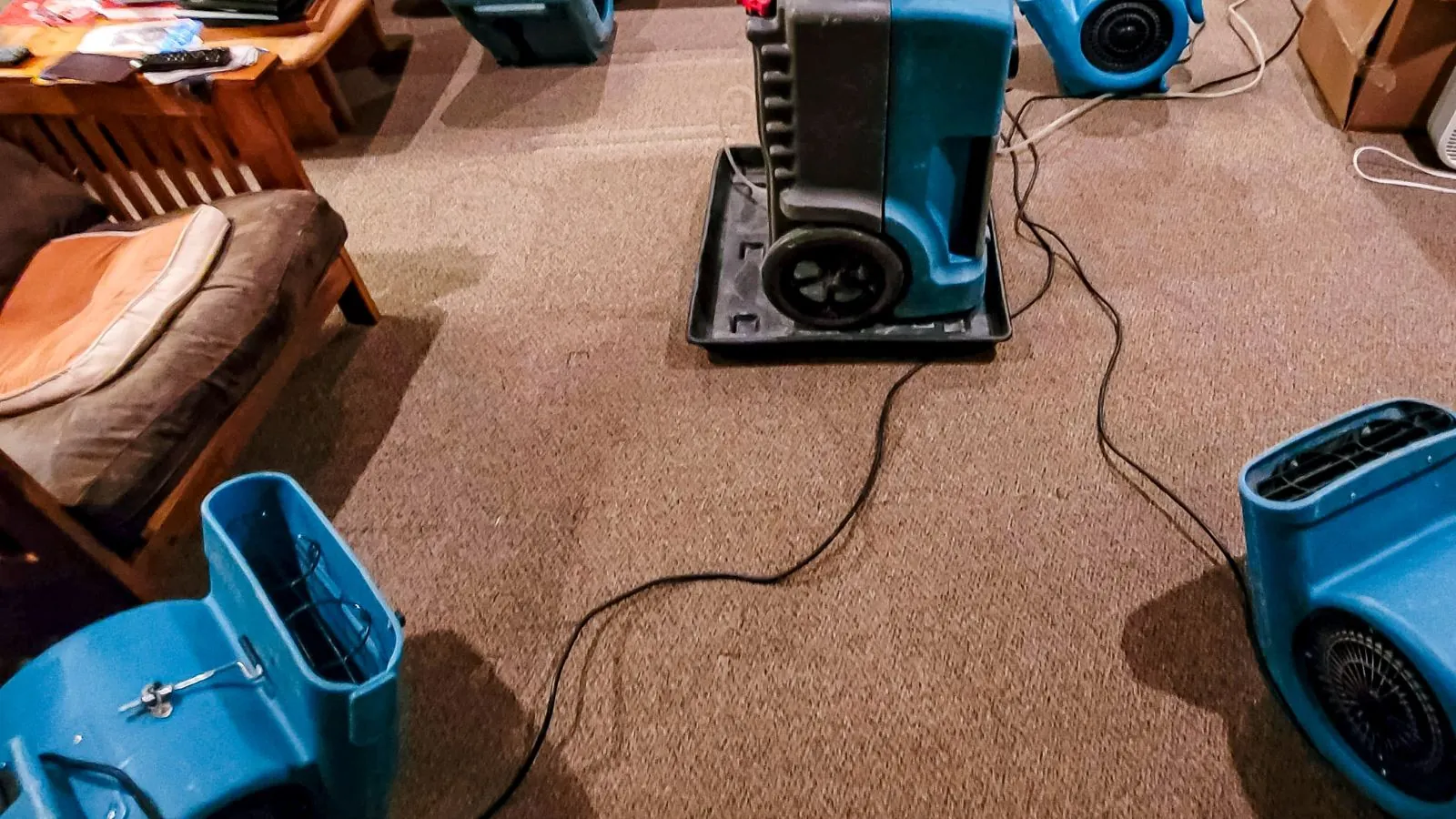
Structural drying in Saint James, NY is the controlled removal of moisture from walls, floors, framing and ceilings after water has soaked in. Crews use moisture meters, thermal imaging cameras, air movers and dehumidifiers, then check the readings every day.
This page explains how that process works, what the equipment does and what the meter has to show before a building counts as dry. If a wall or floor still feels wrong after a repair, the first section is for you.
The wall feels cool and damp days after the leak was fixed
Fixing the pipe stops new water, but it does not remove what the drywall, studs, insulation and subfloor already absorbed. Porous materials hold that moisture long after the surface looks dry. Structural drying is the process that pulls it out until a meter says the materials are back to normal.
Cool is the clue. Evaporation chills a surface, so a wall that stays cool under your palm is usually still giving off water. A musty smell, paint that bubbles and baseboards that lift away are the next signs that moisture is trapped inside.
Why buildings dry so slowly after a leak
Water does not stay where it landed. It wicks upward through drywall, runs down inside wall cavities and soaks into the bottom plate, and it hides behind cabinets, tile and baseboards where air never reaches. Dense materials such as hardwood and concrete release moisture far more slowly than carpet or paint.
Cold or humid seasons slow drying further, because air that is already loaded with moisture takes up less from the wet materials. For that reason crews keep equipment running until the readings say the job is done, not until a calendar date arrives.
How moisture mapping and thermal imaging find the wet areas
A drying crew begins by measuring. Pin and pinless moisture meters read the drywall, framing and flooring, and the numbers are marked on a sketch of the room. A reading from an unaffected area of the same material sets the dry reference, so every wet reading has something real to be compared against.
A thermal imaging camera adds a second view. Wet insulation and damp drywall show up as cool patches on the screen, which helps a crew find water behind a wall without cutting it open. The camera shows temperature, not moisture, so the meter still has to confirm what the picture suggests.
A hygrometer logs the air itself, including temperature, relative humidity and grains per pound of moisture. Those readings tell the crew whether the dehumidifiers are actually removing water or just recycling damp air.
The drying process step by step
- Water that is still standing is removed first with pumps and extraction units, as described on the water extraction page.
- Materials that cannot dry, such as saturated insulation, carpet pad and swollen baseboard, are cut out and bagged.
- Air movers are placed to push air across wet surfaces, and dehumidifiers are sized to the volume of the space.
- Cavities that air cannot reach are opened, or small holes are drilled so warm, dry air can be injected into them.
- Readings are taken and recorded every day, and equipment is moved or removed as areas reach their goals.
- A final set of readings is compared to the dry reference before the equipment leaves.
Air movers, LGR dehumidifiers, desiccants and injectable drying
Air movers are high-velocity fans that sweep a thin layer of moist air off wet surfaces so more moisture can evaporate. Dehumidifiers then remove that moisture from the air. An LGR dehumidifier, short for low grain refrigerant, cools the air to condense water and works well in warm, wet rooms. A desiccant dehumidifier passes air over a drying wheel and holds up better when a space is cool or the air is already fairly dry.
Injectable drying uses hoses and small drilled ports to push dry air straight into a wall cavity, under a kitchen toe-kick or beneath flooring. It can save drywall that would otherwise be torn out, which is why it matters on a finished wall or drywall job. Under hardwood, mat systems pull moisture through the boards, and the hardwood floor page covers what that means for your boards.
Drying goals, daily monitoring and the S500 standard
ANSI/IICRC S500 is the published industry standard for professional water damage restoration. It treats drying as a measured job with a stated goal, set by comparing wet materials to the same materials in an unaffected part of the building. Ask any company whether its crews work to S500, and ask how the goal for your building will be set.
Daily monitoring is what separates drying from leaving fans running. At each visit the tech records meter readings, air conditions and equipment settings, then adjusts. A wall can read dry on the surface and still hold water inside, which is why the meter and the log, not the look of the room, decide when a job is finished.
Material, drying approach and what the meter must show
No two materials dry the same way. This table shows the usual approach and the result a meter has to confirm. No day counts appear because the readings, not a schedule, decide.
| Material | Typical drying approach | What the meter must show |
|---|---|---|
| Drywall | Air movers on the surface, removal or flood cuts if saturated or contaminated | Readings match the dry reference wall, and thermal images show no cool patches |
| Wood studs and framing | Air pushed into the cavity, sometimes with injected warm dry air | Readings return to the reference for that wood in an unaffected area |
| Fiberglass insulation | Usually removed, because it holds water against the framing | The cavity behind it reads dry before new insulation goes in |
| Plywood subfloor | Dehumidifier and air movers, with drying mats from above or below | Subfloor matches the reference and stays there after equipment is paused for a check |
| Hardwood flooring | Mat systems that pull moisture through the boards under slow, controlled drying | Boards and subfloor at reference, with no new cupping showing |
| Concrete slab | Dehumidification and steady air flow, often the slowest material | Readings meet the limit set by the flooring maker for what goes on top |
| Carpet and pad | Pad usually discarded, carpet dried only if the water was clean | Backing and the subfloor beneath both read dry |
Where water mitigation ends and structural drying begins
The first stage is the emergency work that limits harm right away by stopping the source, removing standing water and protecting belongings. Structural drying is the longer second stage, where the building itself is dried to a measured goal. Skipping the second stage is how homes end up with a repaired pipe and a moldy wall a few weeks later.
If mold is already visible, drying comes first and the removal is a separate scope, as laid out on the mold remediation page. Mold work follows ANSI/IICRC S520, and New York licenses the people who do it.
Safety checks while drying equipment runs
Drying equipment runs for days, so a few habits keep the setup safe and effective.
- Keep equipment cords out of standing water and do not daisy-chain extension cords
- Leave air movers and dehumidifiers where the crew placed them
- Keep children and pets away from running equipment
- Do not turn off equipment to save power without asking the crew
- Report any new stain, smell or warm wall right away
When to call 911 instead
Call 911 if equipment sparks, smokes or smells like burning plastic. Unplug only if you can do so safely, then step outside.
What affects the cost of structural drying
Drying cost depends on how much of the building is wet and how stubborn the materials are. Expect these factors to shape any quote.
- Water category, because contaminated water means more removal and less salvage
- Affected area, including square footage, wall cavities and how many floors the water reached
- Materials, since hardwood, plaster and concrete dry more slowly than drywall and carpet
- Drying days and equipment, meaning how many air movers and dehumidifiers run and how many monitoring visits are needed
- Rebuild scope, from replacing a few feet of drywall to refinishing floors
Insurance and getting a number
Sudden and accidental water damage is often covered, while gradual leaks and neglect often are not, and flood is usually excluded, so check your policy. Call (934) 223-1875 and describe what you are seeing, and the scope and price are explained before work starts. We also dispatch to homes in Nesconset and other nearby towns.
Frequently asked questions
Why is my wall still damp after the leak was fixed?
The pipe repair stopped new water, but the drywall, studs and insulation kept what they had already absorbed. That water leaves only when air moves across the surface and a dehumidifier takes it out of the room. A moisture meter tells you whether it has finished leaving.
How do I know the structure is actually dry?
Meter readings on each material have to match the dry reference taken from an unaffected area, and they should hold steady when equipment is paused for a check. Touch and smell are not enough, since a wall can feel dry and still hold water inside.
Do the machines have to run all the time?
During active drying, yes, because pausing lets moisture settle back into the materials. The equipment is loud and uses electricity, so ask the crew how long they expect it to stay and what the daily readings show.
Can a store-bought dehumidifier do the same job?
A household unit handles damp air but not the wet material. It lacks the air movers that push moisture off surfaces, the injection tools for wall cavities, and the meters that show when to stop.
What is the difference between LGR and desiccant dehumidifiers?
An LGR unit condenses water out of warm air using a cooled coil. A desiccant unit absorbs moisture onto a drying wheel and does better in cool spaces or very dry air. Crews choose based on the room conditions and the materials.
Will you drill holes in my walls?
Sometimes. Small ports let dry air into a closed cavity, and they are patched afterward. It is often cheaper than removing the drywall, but if the wall is saturated or contaminated, removal is the better call.
Is structural drying covered by insurance?
If the water damage itself is covered, the drying that fixes it is typically part of the claim, but your policy decides. Ask your insurer, and document the damage before cleaning anything up, as New York DFS advises.