
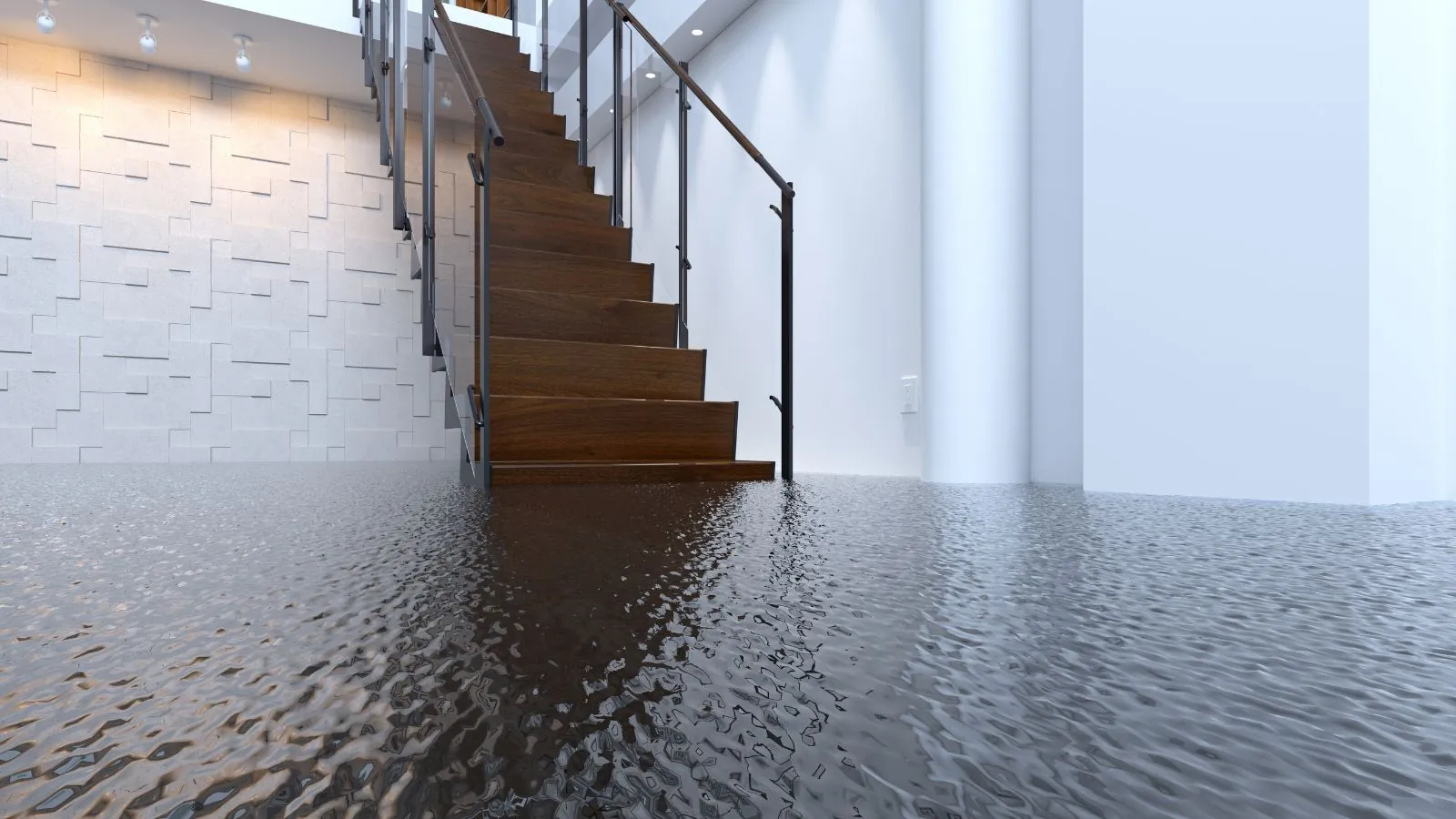
Commercial water damage in Saint James, NY is any water loss in a shop, office, restaurant or multi-unit building, where downtime, shared walls and insurance paperwork make the job bigger than the wet floor. Our 24/7 line is (934) 223-1875.
We know every closed hour costs you money. While you wait, stop the water at its valve, keep people out of wet areas and photograph everything before it is moved, because your insurer will want proof of what the room looked like.
Why water in a business building spreads differently
A commercial space has more ways to lose control of water than a house. Long runs of pipe sit above drop ceilings, sprinkler and HVAC lines cross unit boundaries, and floors are often slab with carpet tile or vinyl glued on top. A leak that starts in one suite can reach the next through shared ceilings, wall cavities and floors.
Our own address is in the Green Hills Shopping Center on North Country Road (NY 25A), and strip retail lines that road. In strip-style buildings, units sit side by side under one roof, so a loss next door is also your problem until someone confirms where the water stopped. Ask your neighbors and the property manager the same day.
Water in the building right now and what to do first
The order matters more than speed. Work through these while the dispatcher gets a crew moving.
- Find the source and close the nearest fixture or zone valve. If you cannot find it, close the building's main supply valve.
- Do not touch a fire sprinkler system yourself. Call the building's fire protection contractor or the landlord's emergency number instead.
- Look at the electric panel from a dry spot. If water has reached outlets, cords or equipment and you cannot reach the breaker dry, call PSEG Long Island at 1-800-490-0075 to cut power at the meter.
- Lift stock, files, laptops and tools onto shelves or tables, and cover server racks with plastic sheeting.
- Rope off wet floors and keep staff and customers out of any area where the water looks dark or smells like a drain.
- Photograph and video the damage from the doorway, then close-ups of the source, the stock and the equipment, before anything is cleaned.
Do not wait on the landlord to start
Notify the property owner right away, but do not hold off on stopping the water and calling for help. Delay is what turns a wet carpet tile into a failed subfloor.
Who handles what, tenant or landlord
For commercial space, the lease usually decides who repairs what. Some leases make the tenant responsible for the interior and the landlord for the roof, structure and shared plumbing. Others reverse it. Read the repair and insurance clauses and send the property manager a written notice with photos.
Residential units in a multi-unit building are different. New York Real Property Law 235-b treats a landlord as warranting that the premises are fit to live in, and a tenant cannot waive that. Either way, notify early and keep copies of every message.
Affected space, first action and who to notify
Use this as a quick guide for the first hour. Adjust it to the building and your lease.
| Affected space | First action | Who to notify |
|---|---|---|
| Retail sales floor | Stop the source, lift stock off the floor and block off wet areas | Landlord or property manager, your insurer and the dispatcher |
| Office with computers and files | Shut down and unplug equipment only if the outlets are dry, then move it to a dry room | Your IT contact, landlord and insurer |
| Server or electrical room | Stay out if water has reached outlets or the panel, and cut power at the source or meter | Building engineer or electrician and PSEG Long Island if the breaker is unreachable |
| Restaurant kitchen or back of house | Close the fixture valve, cover or move food and stop using wet appliances | Manager, landlord and insurer |
| Shared hallway or stairwell | Keep people off wet floors and close the riser valve if it is labeled and reachable | Building owner, the affected units and your insurer |
| Ceiling below another unit | Contain the drip with sheeting and buckets, and move belongings away | Tenants above and below, plus the landlord |
How a commercial loss is extracted, dried and measured
A crew arrives with extraction units for standing water, then maps moisture through floors, walls and ceilings with moisture meters and a thermal imaging camera. Air movers and LGR dehumidifiers go in next, and large offices often need several dehumidifiers staged across the floor plate.
Wet carpet tile, ceiling tile and insulation are removed where they cannot dry. Readings are recorded at every visit until each material matches a dry reference, as laid out on the structural drying page. Ask any company whether its crews work to ANSI/IICRC S500, the published standard for water damage work.
If the water came from a drain or sewer line, the job changes. Contaminated water needs protective gear and tighter removal rules, and the sewage backup page explains why.
Documentation for your business insurance
Your insurer will want evidence, so build it as you go. New York DFS advises that you file claims as soon as possible and document your losses before cleaning anything up.
Keep a dated record of when the leak started, when you found it and every call you made. Photograph or video the damage, list damaged stock and equipment with quantities, and save receipts for emergency costs. Drying logs and the written scope from the crew become part of the file. Ask your insurer if the policy covers lost income during a closure and what proof it needs.
Downtime, after-hours access and rebuilding
A business rarely can close for long, so tell the dispatcher your hours, who holds the keys and alarm codes, and which rooms must reopen first. Work can then be planned around your schedule. Containment with poly sheeting and a dedicated dry zone can let part of a space keep operating, depending on the layout.
For rebuild work, ask the Town of Smithtown Building Department, the permit office for buildings in Saint James, whether the repair needs a permit. That question is most likely to come up when walls, electrical or plumbing are opened. Landlord approval may also be required. For rising water from outside, see flood damage cleanup.
What affects the cost of commercial water damage
Commercial jobs vary widely, so no responsible number can come before the scope. These are the drivers.
- Water category, since clean supply water, gray water and sewage are handled very differently
- Affected area, including how many suites, floors or ceilings the water reached
- Materials, such as carpet tile, ceiling grid, drywall, cabinetry and stock
- Drying days and equipment, covering extraction, air movers, dehumidifiers and daily readings
- Rebuild scope, which depends on the lease and who owns the finishes
Insurance and getting a number
Sudden and accidental water damage is often covered by business policies, while gradual leaks and neglect often are not, and flood is usually excluded, so check your policy. Call (934) 223-1875 and the scope and price are explained before work starts. We also serve Smithtown businesses.
Frequently asked questions
Do you handle commercial water damage emergencies at night or on weekends in Saint James?
Yes. Dispatch runs 24/7, so a call after closing or on a Sunday gets answered. Same-day response is offered when available, and no arrival time is promised, since it depends on crew location and road conditions.
Who pays, me or my landlord?
The lease usually answers that. Many leases split responsibility between the tenant's interior and the landlord's structure and shared systems, but wording varies. Notify the landlord in writing, and ask your insurer what your policy covers.
Can my business stay open during drying?
Sometimes, in part. If the loss is limited to one area, containment and dry zones may allow the rest to operate. Noise from fans and dehumidifiers can still affect customers, so plan around that.
What should I photograph for my insurer?
Take wide shots of each room, close-ups of the source and damaged stock, equipment labels, and the water line on walls. Do it before anything is moved or cleaned, as New York DFS advises.
Do you work in multi-unit buildings with several tenants?
Yes, the work is often split by unit. Because water travels through shared ceilings and walls, the crew checks neighboring spaces, and the property manager has to coordinate access.
What if the leak is in a sprinkler or fire line?
Leave the system alone and call the building's fire protection contractor or the landlord's emergency line. Once the line is secured, the wet building materials can be extracted and dried.