
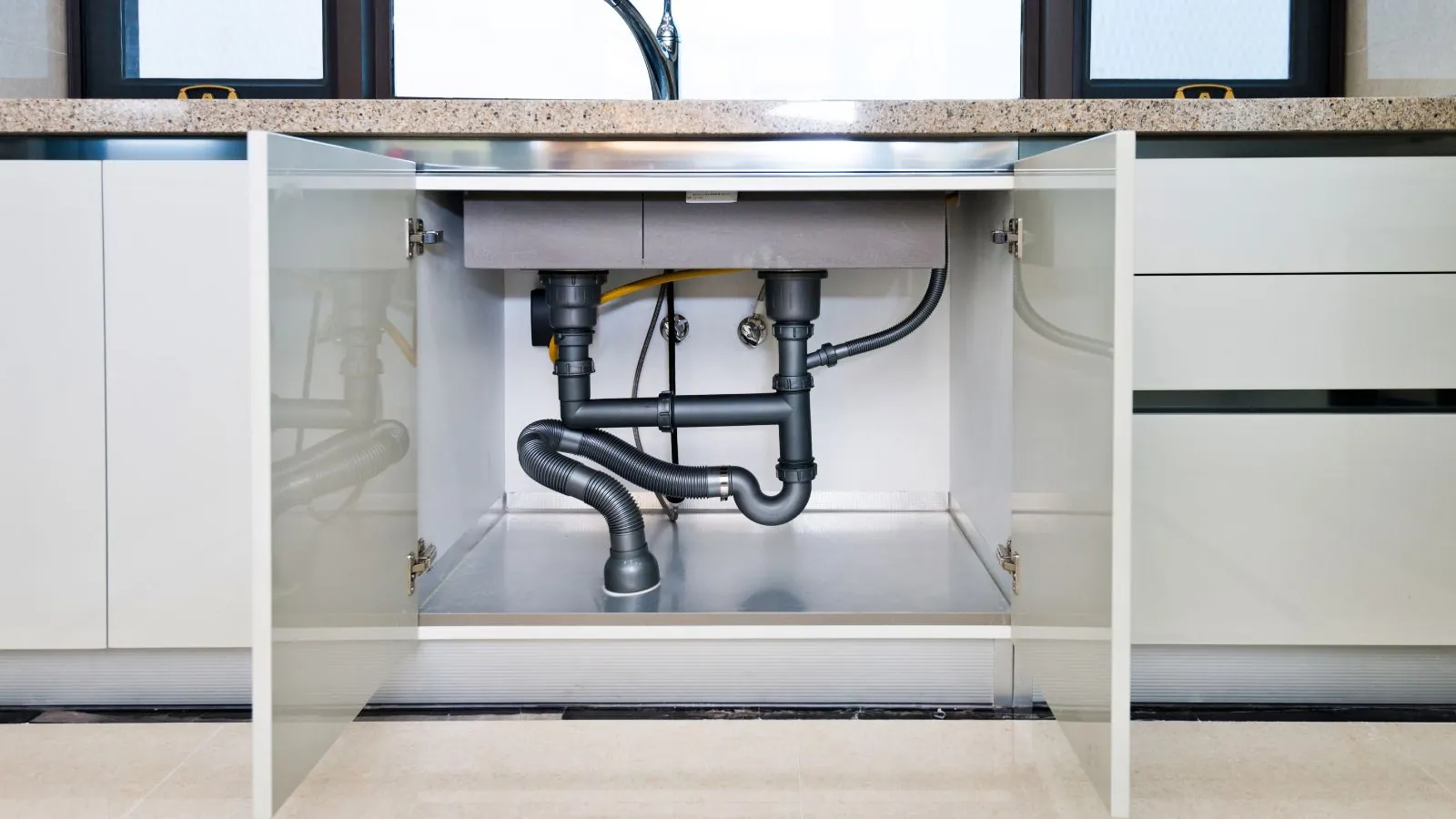
Kitchen water damage in Saint James, NY is water that has soaked the cabinet boxes, the countertop substrate or the subfloor beneath them, usually from a slow supply line, a leaking drain trap or a spill that ran under the toe kick. The puddle on the tile is rarely the whole problem.
This page covers cabinets, the sink area and the floor under them. If the leak started inside a dishwasher or refrigerator, the appliance leak page covers that source.
Why a small kitchen leak spreads under the cabinets
A kitchen packs supply lines, a drain trap, a disposal and a dishwasher hose into one wet zone, and every cabinet box in it sits on the subfloor like a lid. Water that escapes does not stay where you can see it. It runs down the back wall, drops through the pipe cutouts in the cabinet floor and settles on the plywood below.
Most of these leaks are slow. A braided supply line that weeps, a compression nut on the P-trap that has loosened or a disposal flange seal that has dried out can add a cup of water a day without a single puddle on the floor. That is enough to swell a particleboard cabinet floor and wet the underlayment under the toe kick.
Signs the cabinets or the floor beneath them are wet
Start with the sink base, because that is where most kitchen leaks begin. Empty it, shine a flashlight along the back wall and press the cabinet floor with your thumb. A panel that feels spongy, shows a water ring or has swollen edges is holding moisture.
- Doors or drawers that rub, bind or no longer line up with the frame
- Laminate or veneer lifting from the cabinet face or from the cabinet floor
- A musty smell that gets stronger when you open the sink cabinet
- Rust on the supply fittings, the shutoff valve or the bottom of the disposal
- Floor tile or vinyl along the cabinet edge that has loosened, cupped or darkened
- A countertop seam near the sink that has opened or started to swell
How kitchen water damage is found and dried
A crew starts with a pin-type moisture meter and a pinless one, then sweeps the cabinet faces and walls with a thermal imaging camera to trace the cooler, wetter areas. Each material gets its own number, so the sink base can be compared with a dry cabinet on the far wall. Those readings become the baseline for the drying log.
Then the toe kick comes off. Removing the toe kick lets crews see and dry the cavity under the cabinet run, where the subfloor and the bottom edge of the boxes are wetter than anything above them. Without that opening, warm air never reaches the wet surfaces, and the floor stays damp long after the cabinet face feels dry.
Air movers then push air through the open toe kick and drawers while LGR dehumidifiers pull the moisture out of the room. Where a cabinet bottom cannot be reached, an injectable drying system sends dry air through small holes into the cavity. The space beside the dishwasher is checked the same way, since water travels along the subfloor from one opening to the next.
Daily readings decide when drying ends, using the same moisture mapping explained in our structural drying process. Equipment stays until the cabinet floors, toe kick and subfloor read close to the dry standard set on day one.
Dry the cabinets or replace them? Material by material
What the cabinet boxes are made of decides most of this. Open the sink base and look at the raw edge of the cabinet floor, because the face frame can be solid wood while the box behind it is something else. A face that looks fine can hide a failed box.
| Cabinet material | How it reacts to water | Dry or replace |
|---|---|---|
| Solid wood | Swells and can cup, but the fibers tolerate wetting and recover if dried evenly | Usually dried in place, then refinished or touched up |
| Plywood | Layers can separate at cut edges, though sealed faces resist a short exposure | Often dried when caught early, replace any panel that has delaminated |
| Particleboard | Soaks up water like a sponge, swells at the edges and loses its screw-holding strength | Usually replaced once the floor or sides have swollen |
| MDF | Swells, breaks down when wet and does not shrink back to its original thickness | Usually replaced if the core has swollen or the face is peeling |
Countertops, subfloor and the work behind the cabinets
Stone, quartz and solid-surface tops usually survive a leak, but the substrate under them may not. Laminate tops are built on particleboard, so a wet sink cutout swells from underneath and the edge around the sink is the first place to open. If the sink has to come out to dry the top, the plumbing is disconnected and reset afterward.
The subfloor under the cabinets is the part owners forget. Plywood subfloor often dries in place once the toe kick is open. Swollen, soft or sour-smelling OSB or particleboard subfloor may need a section cut out and patched, and flooring is repaired only where it meets that opening.
Safe steps while you arrange a visit
Kitchen leaks rarely call for panic, but the first few steps decide whether a small loss stays small.
- Close the angle stop, the small oval valve on each supply line under the sink, or the main shutoff if you cannot reach them.
- Empty the cabinet and photograph the damage before cleaning anything up. The NY Department of Financial Services advises documenting losses before you clean.
- Unplug the disposal and stay clear of any outlet inside or beside a wet cabinet.
- Leave the cabinet doors open and aim a household fan at the opening, but keep a heat gun or hair dryer away from the wood.
- Do not pry up flooring or pull off cabinet faces. Readings come first because they decide what is removed.
What affects the cost of kitchen water damage repair
A photo cannot produce an honest number. These are the factors that set the scope.
- Water category, since clean supply water and gray drain water are handled differently
- Affected area, meaning how many cabinet runs and how much subfloor are wet
- Materials, because particleboard and laminate tend to be replaced while solid wood is often dried
- Drying days and equipment, including air movers, dehumidifiers and daily monitoring
- Rebuild scope, such as cabinet boxes, countertop resets, plumbing reconnection and flooring patches
Insurance and getting a real number
A sudden break is often covered by a homeowners policy, but a slow leak that went unnoticed often is not, so read your policy or ask your insurer.
Call (934) 223-1875 and describe what you see, and the scope and price are explained before work starts. We serve Saint James and nearby towns, including Nesconset.
Frequently asked questions
Can wet kitchen cabinets be saved?
Often, when the box is solid wood or plywood and the wetting was caught early. Particleboard and MDF that have swollen rarely return to shape, so those are replaced one run at a time. A meter reading at the cabinet floor and sides settles it.
How long do kitchen cabinets take to dry?
It depends on the material, how long it stayed wet and the equipment on site. Plan on several days with daily readings, not a single visit. Crews end the job when readings reach the dry standard, not when the surface feels dry.
Why does the crew remove the toe kick?
The toe kick is the thin board that closes off the open space under the cabinet run. Taking it off gives air movers a path into that cavity and lets the crew put a meter on the subfloor. It is simple to reinstall or replace afterward.
Do I have to remove the countertop to dry the cabinets?
Not always. Most drying happens from the toe kick, the open drawers and the sink base. The top comes off only when its substrate is wet or the cabinet below cannot be reached any other way.
Can a slow leak under the sink cause mold?
Mold needs moisture, and a cabinet that stays damp for weeks supplies it. If you see dark spotting or notice a musty smell, read how containment and removal work on the mold remediation page. Health questions belong with a physician.
Will my insurance cover a kitchen leak?
It depends on the cause and your policy. A sudden burst or overflow is often covered, a long-running drip often is not. Document the damage first and ask your insurer what applies.