
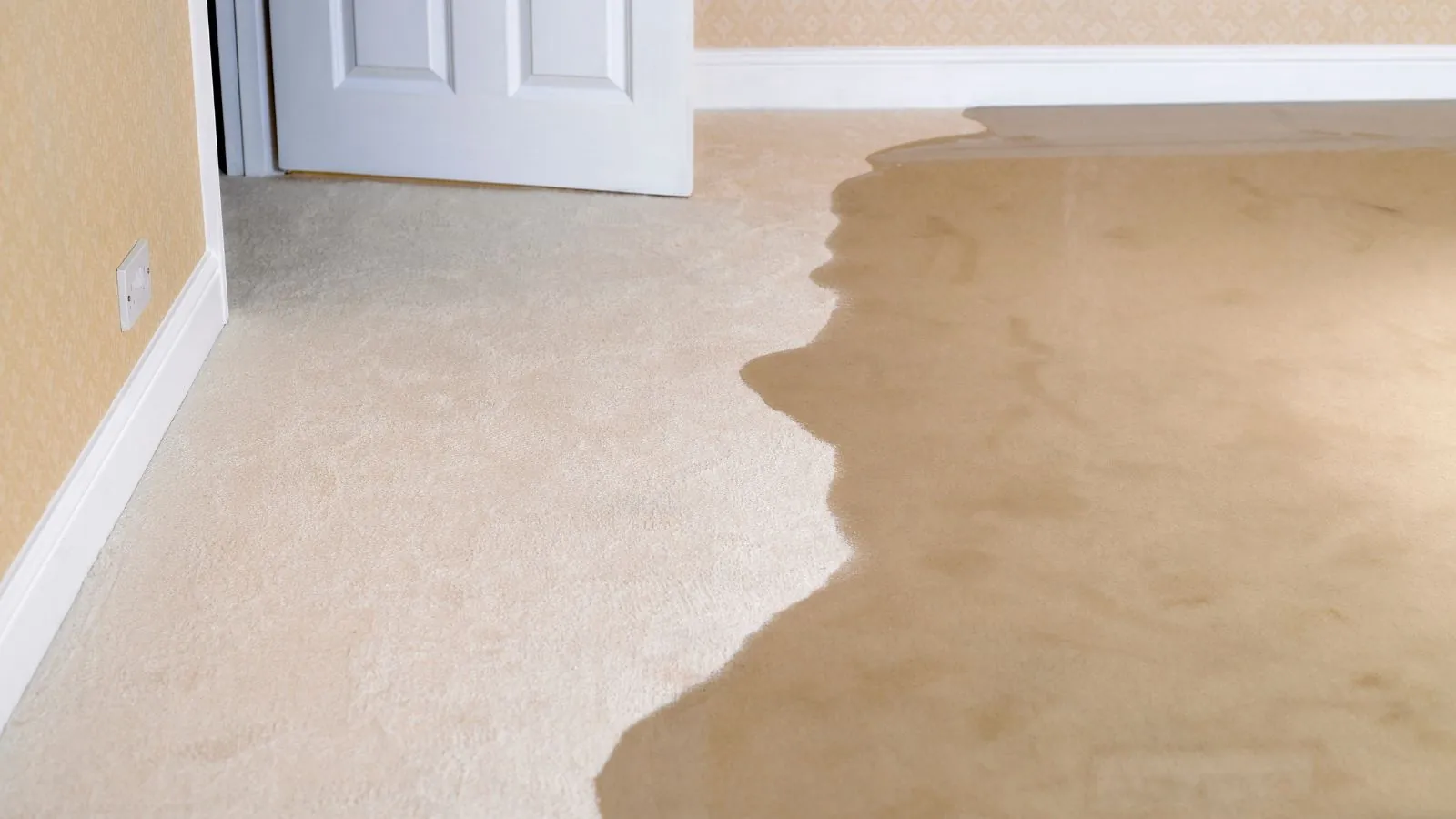
Carpet water damage in Saint James, NY is water that has soaked the carpet face, the pad underneath and often the subfloor below, and that last layer decides how quickly mold can follow. Carpet is a sponge sitting on a second sponge, so the surface can feel nearly dry while the pad holds the rest.
This page explains the three water categories, when carpet is worth saving and when it has to go. If water is still pooling, start with water extraction.
Why carpet stays wet long after the top feels dry
A carpet system has four layers. Fibers sit on a woven backing, the backing rests on a foam or fiber pad, and the pad lies on the subfloor. Water wicks sideways through the pad, so a spill the size of a dinner plate can become a wet patch the size of a bedroom rug.
Wall-to-wall carpet is also stretched over tack strips, the narrow wood strips with pins that run along each wall. Water collects at those edges and soaks the strips and the bottom of the baseboards. A washing machine overflow, which the appliance leak page covers, tends to follow this pattern.
Water category decides whether carpet can stay
ANSI/IICRC S500, the published water damage standard, sorts water into three categories. Category 1 comes from a clean source such as a supply line or a sink overflow. Category 2 carries significant contamination, like discharge from a washing machine or dishwasher.
Category 3 is grossly contaminated, such as sewage or rising floodwater from outside. Water also moves up a category the longer it sits, so a clean-water leak left in a pad for days is no longer a clean-water job. Sewage cases are covered on the sewage backup cleanup page.
Signs your carpet is wet or past saving
Walk across the room in socks and press your foot into the carpet. A squish, a cold feel or a visible darkening means the pad is wet. A damp, sour smell is a stronger warning than any stain.
- Dark patches or tide lines along walls, doors and furniture legs
- Carpet that ripples, lifts or has pulled loose from a tack strip
- A musty smell that comes back after the surface dries
- Backing that peels apart when you lift a corner
- Staining on the baseboard that matches a damp spot in the carpet
How wet carpet is dried or removed
Extraction comes first, using a portable or truck-mounted extraction unit to pull water out of the face fibers and the pad. A moisture meter and a thermal imaging camera then show how far the water has traveled. If the carpet is a keeper, a corner is released from the tack strip and the carpet is lifted and floated on air movers while the pad underneath is removed.
The pad is nearly always replaced, even when the carpet is saved. Foam holds water and is inexpensive to swap, and it cannot be dried as reliably as the carpet above it. Tack strips that are soaked or warped are replaced, and the subfloor is dried with air movers and LGR dehumidifiers until meter readings match a dry reference.
An antimicrobial treatment is a liquid applied to the backing and subfloor that is meant to limit the growth of bacteria and mold while materials dry. It is an added step, not a substitute for drying, and it does not make Category 3 carpet safe to keep.
Save or replace, by water category and time wet
This table is a general guide. A meter reading and the actual source of the water settle each case.
| Water category and time wet | Save or replace | Why |
|---|---|---|
| Category 1, extracted and dried promptly | Carpet usually saved, pad replaced | Clean water has not had time to degrade, and the fibers can be dried in place |
| Category 1, left wet for a long stretch | Often replaced | Standing dampness lets contamination and mold become a concern, and the pad stays soaked |
| Category 2, caught early | Decided case by case, pad replaced | The source and the carpet type decide whether cleaning in place is realistic |
| Category 2, left wet | Replaced | Contaminants have soaked into backing and pad, and drying alone does not remove them |
| Category 3, any time wet | Removed and discarded | Sewage or floodwater contamination cannot be cleaned out of carpet fibers |
Mold risk if carpet stays wet
Mold needs moisture, and a wet pad against a wet subfloor holds moisture for a long time because air cannot reach it. That is why a carpet that smells musty days after a leak is a bigger concern than one that looks damp today. Health questions belong with a physician.
If you find dark growth on the carpet back or the subfloor, read how containment and removal work on the mold remediation page. Drying the structure comes first, because cleaning a surface while it stays wet leaves the same conditions in place.
What to do before the carpet is assessed
A few simple moves protect the carpet and your feet while you wait.
- Stop the water at its source, whether that is a supply valve, a hose or a drain, before anything else.
- Soak up what you can with a wet vacuum and towels, and keep shoes off if the water came from a drain or the outdoors.
- Lift furniture off the carpet or slip foil under the legs so rust and dye do not transfer.
- Pick up any rugs, boxes and papers, and hang wet items where air can reach them.
- Photograph the carpet and the water line before you cut or pull anything out.
What affects the cost of carpet water damage restoration
Carpet jobs range from a simple extraction to a full tear-out, and these factors drive the difference.
- Water category, because Category 1 can often stay while Category 3 cannot
- Affected area, including how far the pad is wet beyond the visible stain
- Materials, such as the carpet grade, the pad type and the tack strips
- Drying days and equipment for the subfloor and any lifted carpet
- Rebuild scope, meaning new pad, restretching, seams and trim
Insurance and getting a real number
Sudden and accidental water damage is often covered, while gradual leaks and neglect often are not, so check your policy or ask your insurer.
Call (934) 223-1875 with a description of the source and how long it has been wet, and the scope and price are explained before work starts. We serve Saint James and nearby towns, including Smithtown.
Frequently asked questions
How long can carpet stay wet before it must be replaced?
There is no single clock, because the water category matters as much as the time. Clean water extracted and dried within the first day or two has the best chance. Gray or black water, or any carpet that has stayed soaked for a long stretch, is usually replaced.
Can you save carpet after a washing machine overflow?
Sometimes. Washing machine discharge is Category 2, so the decision depends on how soon the water was removed, the carpet type and the condition of the pad. The pad is replaced in most cases.
Do you always replace the pad?
Almost always. Pad holds water, dries slowly and is the part most likely to trap moisture against the subfloor. Replacing it costs far less than a second round of damage.
Is steam cleaning enough after a leak?
No. Cleaning removes surface soil but does not dry the pad or the subfloor. Extraction, air movement and dehumidification with meter readings are what finish the job.
Why is antimicrobial treatment used on carpet?
It is applied to limit bacteria and mold while the materials dry, mostly on the backing and the subfloor. It supports the drying process and does not replace it.
Will my insurance cover wet carpet?
It depends on the cause and your policy. A sudden overflow or burst is often covered and a long-term leak often is not. Flood is usually excluded from standard policies and needs separate flood coverage.